Seven mondays at Stanford made me look hard at what smoothing everything costs, and why the friction we keep designing out might be the part that mattered.
"Don't let anybody, anybody convince you this is the way the world is and therefore must be. It must be the way it ought to be."
— Toni Morrison, Sarah Lawrence College commencement address, 1988
What a simple thought, yet one we tend to forget quickly. With that reminder, last week I wrapped up a seven week journey through Stanford's Ethics, Technology and Public Policy for Practitioners course.
When I started this course I felt it from the very first class, the uneasiness, the discomfort Rob Reich named that first day and called moral caffeination. We spend so much time inside our work, resisting the constant bombarding of AI news, the endless releases, that we shield ourselves and grow a hard skin, and after a while you stop feeling most of it. So when I stopped and actually went to class and let my guard down, the reality hit hard. And it kept happening, monday after monday, the same feeling, but a different piece of the picture each time. What follows is what those mondays took from me, and the one idea they all kept circling back to.
It started with Le Guin, she took us to Omelas, a city whose happiness rests on a single child kept suffering in a basement, and the only question the story hands you is whether you stay or you walk away. A philosophical question that keeps lingering every day. I carried that discomfort around all week, not knowing yet that it was the frame for everything that came after.
The weeks zoomed in, one piece at a time, on the issues that surface as AI spreads into every aspect of our lives: data protection, decision-making, work, democracy.
One of these gave me the spine of all this, and it is the most ordinary of them, the behaviour every one of us has fallen for at least once. As we move faster and faster to keep pace, we get carried along by the decisions, outsourcing our own judgment so often that we end up handing it to the machine and praising its fairness and objectivity. That is the dangerous move, the one that shifts the question from should machines decide for us at all to what is the correct definition of fairness, and in making that shift we admit defeat to our own sense of right and wrong.
It is the same handing over with our data, only more intimate, and more sneaky. It gets collected, labeled, fed into models, without us ever really knowing what is kept and what is thrown away. We map our entire lives, telling ourselves "I've got nothing to hide," and miss what is really at stake, that what is fine today could be a problem tomorrow. Technology has always been an opaque material, a black box we cannot really see inside, but AI is breaking the mental models we used to have for it, and we should be far more intentional about what we hand over for what we get back.
And it is not just the data. In one of the sessions Zoë Hitzig pointed out something I have not stopped thinking about, that there is no single person in your life you would write your emails with, and do your taxes with, and complain about your partner to, and ask for help on a rental, all of it, the same one. We are doing exactly that now with LLMs, pouring every separate corner of our lives into the same place, like never before. And that does something we barely notice, it builds a kind of trust we never explicitly decided to give, because we are used to trust being spread across a lot of people and a lot of rooms, and now it all collects in one place. Which is a strange and powerful thing to have handed over, and a very efficient surface for manipulation.
All of it goes down so smoothly, and that is exactly what makes it work, none of it ever asks you to stop, and that's probably the root problem of everything. Sometimes making things a bit harder is not an obstacle, it is the moment you are meant to stop and feel the weight of what you are doing, the pause where you can still choose otherwise. We have spent years designing that pause out of every experience, I know it firsthand.
And once we have smoothed all of it away, the costs come due, and we are paying them now more than ever. We blame misinformation, and yes it spreads, but what stuck with me is underneath that. The truth was always the slow option, it has to be checked, sourced, corrected. A lie never asks to be verified, so it travels.
All of this reaches our work too, the whole idea of what a profession is, reshaped while we watch. For the first time cognitive work is the one being disrupted, and we are already seeing what that means, especially for the people just starting out. The entry level is vanishing, those first messy experiences that used to shape you for years are being automated away, handing over the illusion of knowing and setting dependence on these tools as the default, while everyone keeps talking about productivity.
Where do I stand in all of this? I work as a designer, and it is uncomfortable to admit, but design is mostly the thing doing the removing. My whole craft is making things smoother, faster, easier to say yes to, pulling the friction out so nothing, and no one, slows the flow. So I am not standing outside the pattern pointing at it, I am one of the very hands that builds it.
But if I am the one taking it out, I am also the one who can put it back. The work I am leaving with is small, but worth doing more often: keep asking the question everyone would rather skip, because a question put back on the table is a design decision too.
On my own that is close to nothing, and the most freeing thing I heard all course was Cory Doctorow in the closing session saying flatly that you cannot fix any of this alone, that voting with your wallet is a fantasy in the long run. Rob Reich put a finer point on it, in the short run your own action does move things, but in the long run the structure you stand in decides what you were even able to do, both at once, the small move now and the slow work of changing the frame. I thought all of that would flatten me, it did the opposite, it was a relief, the weight goes where it always belonged, on people together, slow and tedious, but worth it. The small practice only matters when it is wired into something bigger.
The minute we accept how things are because that is how it has always been, we make ourselves slaves of what we can see instead of what could be, and we hand the world to whoever profits from us not looking. Moral imagination is a muscle, you either train it or you lose it.
That is where the work is, and I want it with the others who do the removing, so if that’s you, where have you put it back?
This reflection grew out of seven mondays in Stanford's Ethics, Technology and Public Policy for Practitioners, led by Rob Reich and Mehran Sahami. Thanks to them, to the faculty and guests who took the other weeks, and to the people I spent those mondays arguing with.
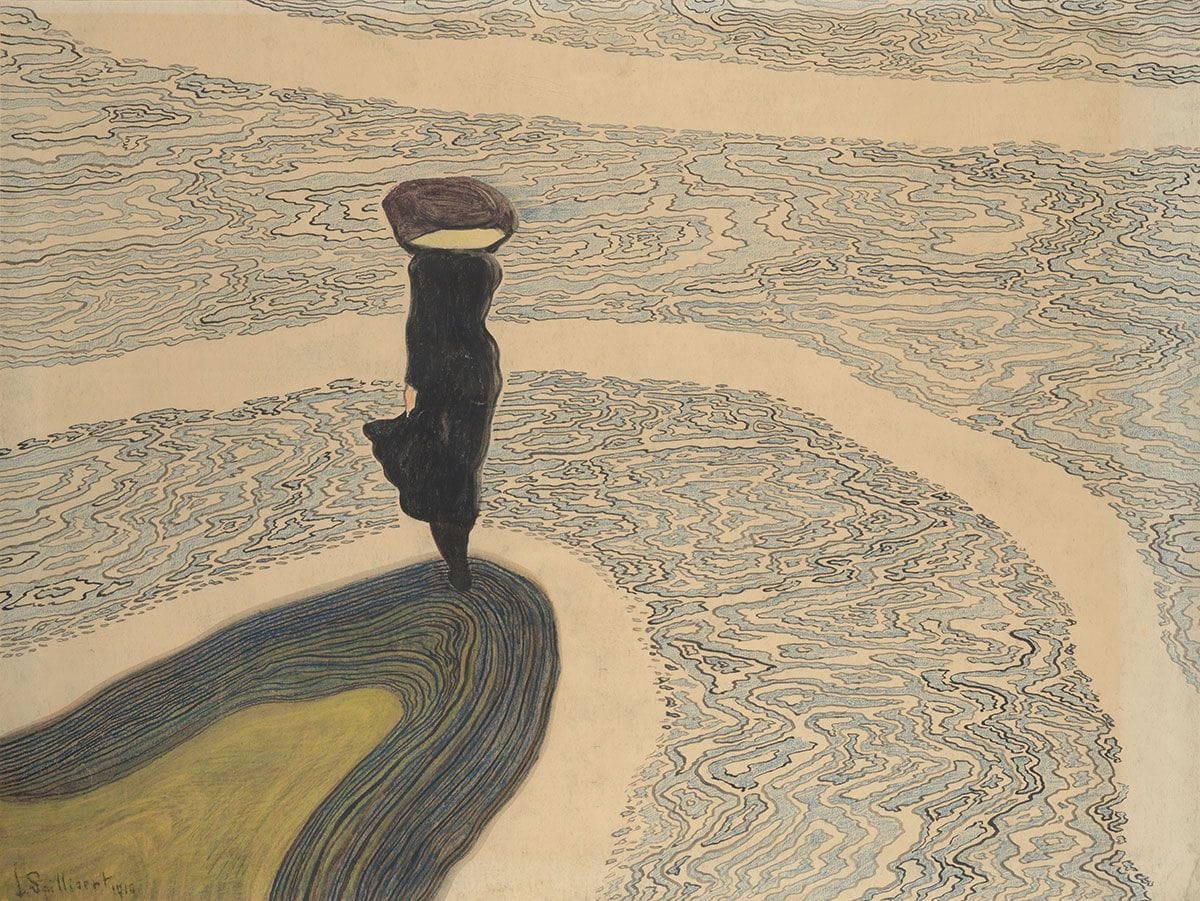
© Léon Spilliaert, Woman at the Shoreline, 1910